 company
 (866) 755-7519











How Rural Hospitals Are Solving Physician Retention
Physician turnover is particularly challenging for regional and underserved healthcare facilities, where replacing a physician is often difficult, and the impact of a vacancy is felt quickly.
When a physician departs, the remaining providers absorb the load, burnout spreads, and the cycle repeats. Physician turnover also creates shortages, especially in cardiology. In 2026 alone, there is a projected shortage of over 3,000 full-time cardiologists. Physician shortages mean talent competition will only intensify. In regional areas, about 86% of counties have no resident cardiologist. These shortages are driven by demographic shifts, training backlogs, and rising rates of cardiovascular disease.
Regional hospitals are breaking the cycle by rethinking how they structure physician partnerships — and the results are proof that retention is both essential and achievable.
Why Physician Retention Is a Distinct Challenge for Regional Facilities
The regional physician retention problem hits underserved facilities harder than large urban systems. These facilities operate with thinner coverage margins, making each departure more disruptive to operations and patient care. Three key pressure points make the challenge distinct:
- Shrinking talent pipeline: The physician shortage projected through 2036 means each departure becomes harder to recover from. Talent competition will only intensify as the shortage deepens, leaving smaller facilities at a disadvantage when competing against larger systems with more resources.
- Credential maintenance barriers: Lower patient volumes at some regional facilities make it difficult for specialty physicians to maintain their clinical credentials. When a facility can’t support the case volume a specialist needs to stay credentialed, retaining specialty physicians becomes significantly more difficult, regardless of job satisfaction. 40% of underserved counties are located in health professional shortage areas, compounding the structural challenge and making recruitment even more difficult.
- Burnout cascade: When one physician leaves, the workload shifts to the remaining team, accelerating burnout and triggering further departures. 27% of turnover-related costs stem directly from physician burnout — a cycle that’s particularly vicious in smaller facilities that face existing coverage challenges.
Retention Strategies That Are Working Right Now
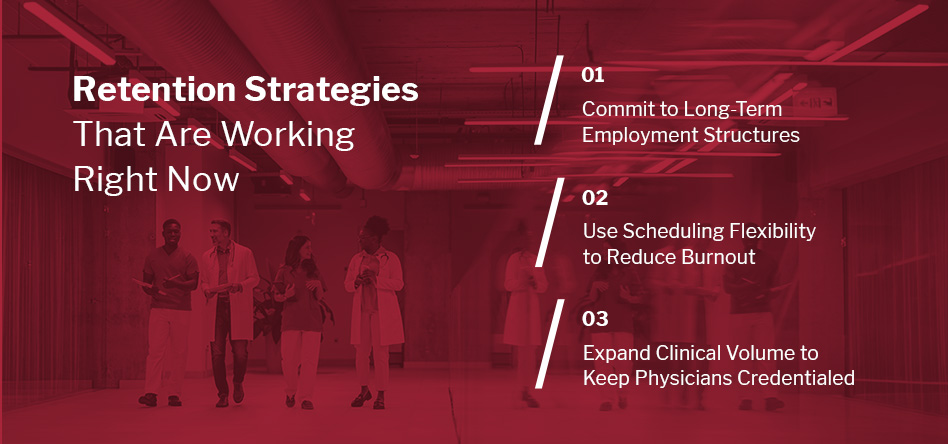
Despite these challenges, regional hospitals are finding practical ways to strengthen physician retention. These proven models offer accessible pathways forward.
Commit to Long-Term Employment Structures
Short-term coverage solves the immediate problem but doesn’t do much to keep physicians around. Multiyear employment structures, by contrast, create the conditions physicians need to integrate into a community, build patient relationships, and find the role sustainable over time.
Sutter Health reduced physician turnover from 9% to 2%-3% over three years by investing in culture, mentorship, and professional development — all elements that require long-term commitment to deliver. What the hospital gains is stability, culture continuity, and dramatically reduced re-hiring costs. What the physician gains is the ability to invest in their practice and community without constantly having to evaluate their next move.
Long-term employment structures are strategic investments in operational stability.
Use Scheduling Flexibility to Reduce Burnout
Predictable schedules, defined rotation patterns, and clear time-off models reduce the burnout that drives voluntary departures, improving retention.
Physicians who don’t feel they have a sustainable path often leave. Addressing schedule-driven exhaustion is an essential operational strategy for hospitals to reduce financial loss.
Telehealth can complement scheduling flexibility by extending coverage without overloading on-site staff. Facilities that integrate telehealth into recruitment and retention gain additional flexibility while maintaining access to care for their communities.
Expand Clinical Volume to Keep Physicians Credentialed
Regional and underserved facilities face a challenge that larger systems don’t — physicians in specialty roles may not get enough case volume to maintain their clinical credentials. The lack of case volume creates a retention problem that is unrelated to compensation or culture.
Interventional cardiologists, for example, must perform at least 50 percutaneous coronary interventions (PCIs) per year to maintain their credentials and board certification. When a facility can’t support that volume, the physician will eventually be forced to leave — regardless of how much they value the role or the community.
The solution is building service line capacity. Growing program volume makes the role clinically viable in the long term, making retention achievable. Administrators may not always consider this angle, but it’s foundational for specialty retention in lower-volume settings. Without adequate case volume, even the most satisfied physician becomes a retention risk.
How a Physician-Led Service Line Partner Reduces Physician Turnover
The strategies above work — but operationalizing all three simultaneously requires infrastructure, expertise, and sustained focus. That’s where a trusted, physician-led service line partner like VitalSolution changes the equation for underserved healthcare staff retention and reduces physician turnover.
VitalSolution is a practice management company, not a staffing firm. Rather than filling seats temporarily, VitalSolution partners with facilities to build and sustain service lines over the long term — a proven model that connects regional hospitals with a supportive community of physician-leaders who understand what it takes to deliver essential care in underserved settings.
The model operationalizes retention best practices in four key ways:
- Long-term physician contracts: Minimum one-year commitments, with typical engagements lasting one to three years, embed providers in the hospital and community for the long haul. VitalSolution helps reduce the gap period that destabilizes care delivery and puts measurable results within reach.
- The 7-on/7-off scheduling model: Physicians work seven consecutive days, then receive seven consecutive days off — 26 weeks off per year while earning full-time compensation. Some opportunities also offer scheduling models with 14 workdays followed by 14 days off. This predictable, sustainable schedule directly combats burnout without sacrificing continuity of coverage.
- Service line management that grows clinical volume: VitalSolution actively builds program capacity, enabling specialty physicians to maintain credentials and remain committed to the facility. Operating across nearly 30 states, VitalSolution supports hospitals with cardiology service line management and anesthesiology staffing solutions designed to increase volume and strengthen access to care.
- The Quality 360 program: Our accountability and quality incentive structure reinforces physician engagement by aligning performance with outcomes, creating a culture of excellence that supports long-term retention. Learn more about the VitalSolution Quality 360 program.
Together, these strategies help hospitals keep physicians and build more stable service lines.
Improve Physician Retention With VitalSolution
VitalSolution’s physician-led service line model addresses the root causes of turnover by offering long-term employment structures, sustainable scheduling that directly combats burnout, and service line management that helps specialty physicians maintain credentials and stay engaged.
VitalSolution’s approach makes quality care accessible for regional communities while creating supportive, sustainable pathways for the physicians who serve them.
If you’re ready to build a retention strategy that works for your facility, contact VitalSolution today to learn how we support long-term physician stability, service line growth, and care access for physician retention in regional healthcare.