company

 (866) 755-7519










The Hybrid Model: Transforming Care in Underserved Communities
More than 85% of rural counties across the country lack a practicing cardiologist, a gap with real consequences for hospital administrators managing specialist coverage. When a hospital cannot provide on-site cardiology coverage, some cardiac patients may need to be stabilized and sent elsewhere for the care they require. A hybrid care model offers an alternative path, pairing on-site clinical teams with remote cardiology expertise so that more patients can receive care close to home.
Making that shift starts with a clear look at why traditional recruitment falls short here, what unmet coverage costs a hospital, and how a hybrid approach can help address both problems.
The Cardiology Coverage Crisis Facing Regional Hospitals
The cardiology coverage crisis facing regional and underserved hospitals extends beyond a simple staffing shortage. It reflects a structural mismatch between where cardiac specialists choose to practice and where hospitals need that expertise on hand to manage cardiac emergencies.
For administrators managing these hospitals across many communities, reliable specialist availability can remain difficult to secure, leaving patient safety dependent on how well the gap is managed.
Why Traditional Recruitment Falls Short in Underserved Communities
Several structural factors work against a hospital’s efforts to recruit full-time cardiologists locally:
- Geographic isolation: Many regional and underserved communities are located hours from major metro areas, often limiting candidates’ access to peer networks, specialized equipment, and lifestyle amenities.
- Professional isolation: Cardiologists practicing alone or in small teams may lack access to case consultation and continuing education that larger urban programs provide.
- Lower patient volume: Regional facilities may see fewer cardiac cases, making it difficult for some physicians, such as interventional cardiologists, to meet the case counts required to maintain their credentials.
Telehealth can give hospitals in underserved areas another option for maintaining cardiology coverage as they evaluate long-term program needs.
What Is the Hybrid Care Model and How Does It Work?
A hybrid care model combines board-certified remote cardiology specialists with a hospital’s existing on-site clinical team, functioning as a single, coordinated program rather than two separate services. This hybrid healthcare approach to telehealth in underserved hospitals allows on-site teams to make care decisions with added input from remote cardiology specialists.
The telehealth component of this model focuses specifically on inpatient and emergency department coverage, keeping supportive specialist backup anchored to the moments when acute cardiac decisions need to be made quickly. In practice, this means remote cardiology support can be structured around scheduled or urgent consult needs, depending on the hospital’s coverage model. At the same time, on-site staff continues to deliver hands-on care, with that expertise accessible when needed.
The Advantages Hybrid Telehealth Brings to Cardiology Service Lines
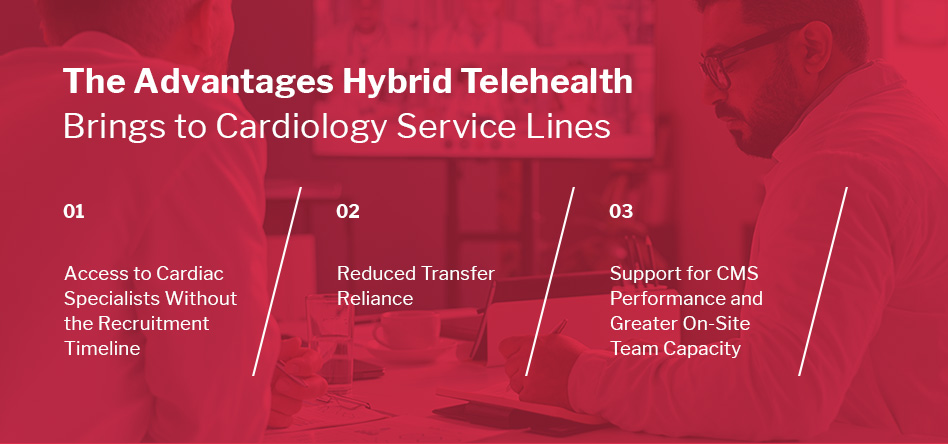
While outcomes depend on implementation, research on hybrid care models points to potential reductions in hospitalizations and healthcare system costs. When a regional hospital adopts cardiology telehealth within its healthcare system, the advantages can span clinical, financial, and operational aspects of its existing service line. Outlined below are some of these advantages that can affect the day-to-day reality for both patients and staff.
1. Access to Cardiac Specialists Without the Recruitment Timeline
Traditional cardiologist recruitment can take several months, and even then, retention in a regional or underserved market isn’t guaranteed. A hybrid model can create a faster path to specialist support than traditional recruitment alone. This can give hospitals access to remote cardiology expertise and create a path for workflow integration over time.
That kind of expanded access makes telehealth for regional hospitals a practical alternative to lengthy recruitment cycles, with remote support that can be structured around peak-period needs or staffing shortages.
2. Reduced Transfer Reliance
When a remote cardiologist is available, regional and underserved hospitals may be able to evaluate and treat some cardiac cases locally rather than defaulting to transfer. Reliable telehealth services in underserved areas can enable more clinically appropriate cases to remain within the hospital, supporting access to care, service-line stability, and revenue retention.
Fewer transfers can also help strengthen the relationship between a hospital and the community it serves. Keeping more care local can help reinforce the hospital’s role as a trusted resource for families who rely on it. Trust like this is just as central to building a sustainable cardiology program for regional hospitals as clinical outcomes are.
3. Support for CMS Performance and Greater On-Site Team Capacity
Real-time decision support from a remote cardiologist can provide on-site teams with timely input as they determine the appropriate treatment path. More consistent documentation and standardized care protocols can also support hospitals’ efforts to meet quality benchmarks that may factor into quality reporting or reimbursement.
Daily operations for on-site clinical teams can also shift in a positive direction. Physicians and clinicians managing complex cardiac cases gain supportive, real-time backup rather than making difficult decisions alone, which can provide additional support during high-pressure care moments.
How Hospitals Can Make the Hybrid Model Work
Adopting a hybrid cardiology model starts with approaching it as a coordinated program. Important considerations include:
- Coverage expectations: Defining which cases route to remote cardiology support, whether inpatient consults, emergency department cases, or a mix based on time of day and staffing, can help set clear expectations early on.
- Integration with existing workflows: Giving remote specialists access to the same imaging, monitoring data, and documentation systems the on-site team uses can help the model run more smoothly.
- Buy-in from on-site clinical staff: Physicians and clinicians who will rely on remote backup should understand how and when to loop in that support, so it is easier to incorporate into daily practice.
- A partner invested in long-term success: Coverage needs rarely stay static, so partnering with a team willing to revisit and adjust the program as case volume, staffing, or service line goals evolve can support a better long-term fit.
In many cases, a hybrid program does not require a hospital to overhaul its existing cardiology service line.
Build a Sustainable Cardiology Program With VitalSolution
A hybrid care model can give many hospitals, including regional and underserved facilities, a practical way to reduce cardiology coverage gaps without relying solely on a lengthy recruitment cycle. Turning that model into a working program takes a partner with the clinical expertise to build and manage it well.
VitalSolution is a physician-led practice management company with a clinically informed approach to building these programs around each facility’s specific needs, focusing on inpatient and emergency department coverage that supports long-term sustainability. If you’re ready to take the next step, contact VitalSolution today to discuss building a cardiology program suited to your facility.